

Last Updated: October 23, 2026
Quick Summary
Expensive footwear is not automatically more comfortable, because comfort is a fit question first and a money question second. Price buys better materials and tighter construction, but a well-made shoe in the wrong shape for your foot will hurt more than a modestly priced shoe that matches your arch, width, and heel preference.
- Score three same-purpose pairs at budget, mid-range, and premium price points on six criteria, then compare totals.
- Bend the forefoot: a good shoe flexes at the ball and resists bending in the middle of the arch.
- Cushioning that stays compressed after you release your thumb will flatten underfoot within weeks.
- Stitched soles can be repaired, while cemented soles usually cannot, which is where price tracks quality.
- A kitten heel between 2 and 3 inches distributes weight more kindly than a stiletto.
Table of Contents
- The Price-Comfort Myth: What the Research Actually Says
- Cheap vs Expensive Shoes: A Controlled Price-Tier Comparison
- What Makes Shoes Comfortable? The Five Factors That Matter
- How to Choose Comfortable Heels Without Sacrificing Style
- Comfort Over Time: Break-In, Durability, and Cost Per Wear
- The Verdict: When Expensive Footwear Is Worth It (and When It Isn't)
- Frequently Asked Questions
The Price-Comfort Myth: What the Research Actually Says
Is expensive footwear actually more comfortable? Not automatically. Price buys better materials and tighter construction, but comfort is a fit question first and a money question second.
A well-made shoe in the wrong shape for your foot will hurt more than a modestly priced shoe that matches your arch, width, and heel preference.
Below, we show you how to separate craftsmanship from marketing and judge a pair before you commit.
Cheap vs Expensive Shoes: A Controlled Price-Tier Comparison
Most price comparisons fail because they compare a $40 sneaker to a $400 loafer. A useful comparison holds the use case constant and varies only price.
Set up a fair comparison
Pick three pairs built for the same purpose, say, a closed-toe everyday flat or a low block heel, at budget, mid-range, and premium price points. Evaluate all three on the same six criteria, on the same day, ideally late afternoon when feet are largest.
- Fit at the widest part, does the widest part of your foot sit at the widest part of the shoe, with no pressure across the ball?
- Toe box volume, can you wiggle toes and spread them without the upper pressing down?
- Heel counter grip, does the heel hold without slipping, and without digging into the Achilles?
- Cushioning response, press the insole; does it spring back, or stay compressed?
- Stability, twist the shoe and press the heel; does the platform resist rolling, especially in a heel?
- Interior finish, run a finger along seams and lining; are there ridges, glue lines, or hard edges?
Score each pair 1-5 per criterion; the highest total is most comfortable for your foot, regardless of price. In practice, the premium pair often wins on criteria 4-6 and the budget pair ties or wins on 1-2, which is why price alone is a poor proxy.
What actually changes across price tiers
| What You're Paying For | Budget Tier | Mid Tier | Premium Tier |
|---|---|---|---|
| Interior lining | Synthetic, often unlined | Cushioned textile or split leather | Full leather or cushioned textile |
| Construction | Cemented, mass-produced | Cemented or partially stitched | Stitched or hand-finished |
| Sizing consistency | Varies between batches | Generally consistent | Tighter tolerances |
| Break-in period | Short but shallow | Moderate | Longer, molds to foot |
| Repairability | Usually none | Sometimes resoleable | Often resoleable |
| Cost per wear | Low upfront, high turnover | Moderate | High upfront, longer life |
The three hand checks that beat the price tag
Before you put a shoe on, do these three checks, they reveal more about build quality than price:
- Bend the forefoot. A good shoe flexes where your foot flexes, at the ball, and resists bending in the middle of the arch. If it folds in half like a taco, the shank is weak.
- Press the insole. Cushioning that stays compressed after you release your thumb will flatten underfoot within weeks. Cushioning that springs back has a better chance of lasting.
- Twist the heel counter. A firm counter holds the heel and adds stability; a floppy one lets the foot roll inward or outward.
A practical in-store and online checklist
Use the same checklist in person or online:
- Try shoes late in the day, when feet are at their largest
- Walk for several minutes, not several seconds, on a hard surface
- Confirm the widest part of your foot aligns with the widest part of the shoe
A controlled comparison will not tell you which shoe is "best", only which is most comfortable for your foot at each price.
What Makes Shoes Comfortable? The Five Factors That Matter
Comfort comes down to five factors: fit, cushioning, support, materials, and breathability. Fit and foot shape decide whether a shoe works at all. The other four decide how long it stays comfortable.
How to Choose Comfortable Heels Without Sacrificing Style
Choosing comfortable heels starts with heel height and width, then fit at the ball of the foot. A kitten heel between 2 and 3 inches distributes weight more kindly than a stiletto, and a wider heel base adds stability.
Work through this checklist before you buy:
- Heel height suits your daily walking distance, not just the event
- Toe box leaves room to wiggle your toes
- Heel counter grips without rubbing the Achilles
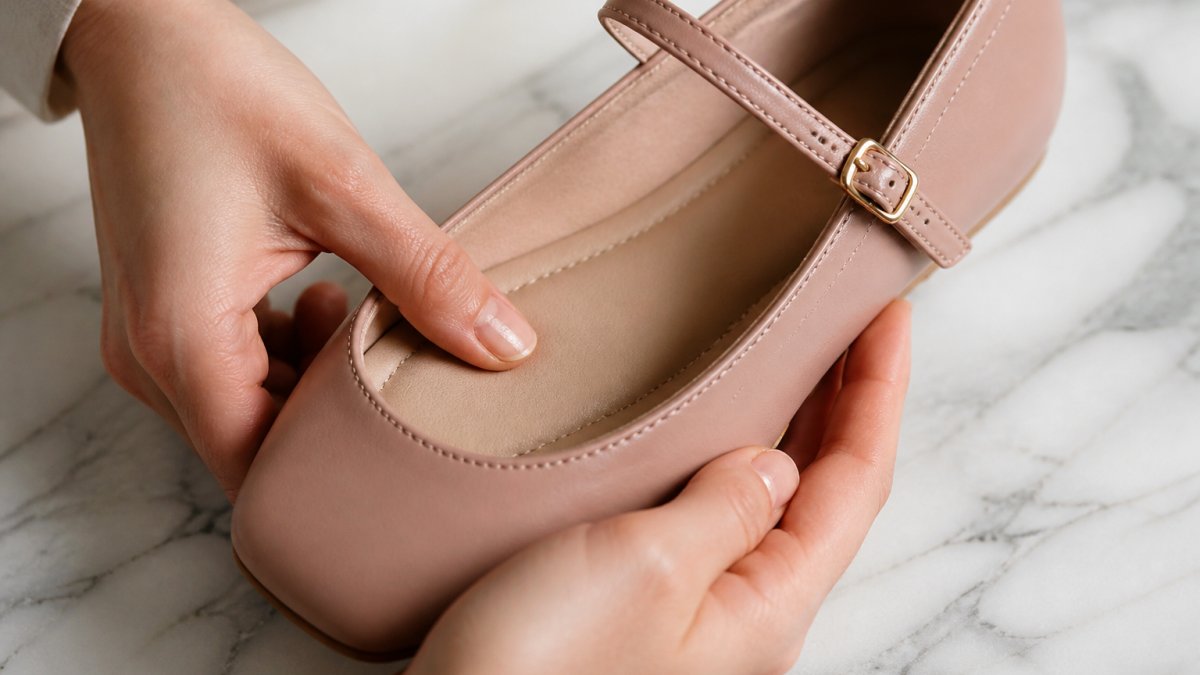
For workdays that run long, a flat is the smarter investment. The First Bloom Mary Jane Flat uses a soft cushioned leather insole with a softly rounded toe and two delicate straps, which keeps pressure off the top of the foot. For cooler months, the Bloom Boot is crafted from supple blush leather with floral embroidery and a signature strawberry charm.


Comfort Over Time: Break-In, Durability, and Cost Per Wear
First-try comfort and long-term comfort are different questions. A shoe can feel wonderful in the store and hurt after two hours, or feel stiff on day one and become your most comfortable pair after two weeks. Knowing which is happening separates a good purchase from a regretted one.
Break-in: what is normal and what is not
Break-in is the process of a shoe adapting to your foot. Leather uppers, linings, and cork or leather footbeds mold gradually; synthetic uppers and foam footbeds generally do not, they hold their shape or compress and flatten.
The First Bloom Mary Jane Flat →
Quality leather shoes typically need a short break-in, a few wears of an hour or two, during which the upper softens across the instep and the footbed takes on your arch's shape.
Use this rule of thumb to tell normal break-in from a poor fit:
- Normal break-in: mild stiffness across the instep or at the heel counter that eases within a few short wears; no numbness, no hot spots that persist, no pinching across the toes.
- Poor fit: pinching across the toe box, pressure on the top of the foot, heel slip that persists after lacing or strapping snugly, or numbness in the toes. These rarely resolve with wear and usually get worse.
Durability: where the money actually goes
Durability is one of the few places where price correlates reliably with quality. Higher-priced shoes more often use stitched construction, which can be repaired, and denser uppers that resist creasing. Budget shoes more often use cemented construction, where the upper is glued to the sole; when the bond fails or the sole wears through, the shoe is usually finished.
Check three things to estimate durability before you buy:
- Construction: stitched soles can be resoled; cemented soles usually cannot
- Upper material: full-grain leather generally outlasts corrected-grain leather, which outlasts most synthetics
- Lining: leather linings tend to resist odor and wear better than unlined synthetics
Cost per wear: the honest metric
Cost per wear is the purchase price divided by the number of times you realistically wear the pair, reframing the question from "what does it cost" to "what does it cost each time I put it on."
Worked example without invented prices: if a budget pair costs one unit and lasts 30 wears, its cost per wear is one-thirtieth of a unit.
Repairability changes the math further
A pair that can be resoled stays in rotation for years; a pair that cannot is disposable by design. Before you buy, ask whether the sole can be replaced and who can do it. A resoleable pair with a good fit is usually the lowest cost-per-wear option, regardless of upfront price.
The takeaway
Judge comfort over time in two stages: first-try comfort tells you whether the fit is right, and break-in behavior tells you whether the materials will adapt. Durability and repairability then decide whether the pair earns its price over years rather than weeks.
The Verdict: When Expensive Footwear Is Worth It (and When It Isn't)
Expensive footwear is worth it when three conditions line up: the last matches your foot shape, the construction allows repair, and you will wear the pair often enough to spread the cost. Miss any one and the premium is hard to justify.
It is not worth it when you are paying for a label on a shoe that pinches, or when the style suits one event and nothing else. Buy the fit first, the craftsmanship second, and the name last.
What matters most is how the pair feels after an hour on your feet, not how it looks in the box.
Frequently Asked Questions
Are expensive shoes more comfortable than cheap shoes?
Not automatically. Price tends to buy better materials, more careful construction, and a shape built on a proper shoe last, all of which can improve comfort. But comfort still depends on whether the shoe matches your foot shape, width, and arch. A well-made shoe in the wrong size will hurt more than a basic shoe that fits. Treat price as a signal of quality, then judge comfort by fit, cushioning, and how the shoe feels after ten minutes of walking.
Do expensive shoes help with foot pain?
They can, when the source of pain is pressure or poor support. Softer leather uppers, cushioned insoles, and a stable heel reduce pressure on the ball of the foot and the heel. A lower heel, around 2.5 inches, also shifts weight forward less than a stiletto. That said, no price point fixes a shoe that is too narrow or too short. If pain persists, see a podiatrist rather than shopping for a more expensive pair.
Are designer shoes comfortable for all-day wear?
Some are, and the heel height is usually the deciding factor. A 2.5-inch kitten heel or a flat with a cushioned leather insole is realistic for a full workday. A 4-inch pointed stiletto generally is not, regardless of price. Look for a rounded or almond toe that gives toes room to spread, a strap that holds the foot in place, and an insole with actual padding. Those details matter more than the label.
How should shoes fit to be comfortable?
There should be roughly a finger's width between your longest toe and the front of the shoe, and the widest part of your foot should sit at the widest part of the shoe. Walk around for at least ten minutes before buying. Heels should not slip at the back, and the ball of your foot should not slide forward. Try shoes late in the day when feet are at their largest, and check both feet since most people are slightly asymmetric.
Can cheap shoes be as comfortable as expensive ones?
Yes, in the short term. A basic flat with a padded insole can feel fine for a season. The difference shows up in durability: cheaper materials crease, soles wear thin, and linings break down faster, so comfort fades. Expensive footwear made with leather and proper construction tends to hold its shape and cushioning for years. If you wear a pair twice a week, the cost per wear often favors the better-made shoe.
The real challenge is finding shoes that feel as good as they look, and that takes more than a price tag. At Strawberry Flowers, we design signature footwear with cushioned leather insoles, considered heel heights, and a romantic aesthetic built for women who walk boldly. Explore the collection and step into a world where every detail is crafted to help you walk like you love yourself.
