

Table of Contents
- Ethical Fashion vs Fast Fashion Quality: The Core Differences
- Production Speed, Volume, and Trend Cycles
- How to Tell If Clothes Are Good Quality: A Practical Inspection Checklist
- Durable Clothing Materials: What Lasts and What Doesn't
- Fast Fashion Clothing Lifespan: How Long Do Cheap Clothes Really Last?
- Cost Per Wear Clothing: The Long-Term Value Calculation
- Environmental Impact, Labor Conditions, and the True Cost
- Exceptions and Variation: When Fast Fashion Surprises and Ethical Fashion Disappoints
- Frequently Asked Questions
Last Updated: October 21, 2026
Ethical Fashion vs Fast Fashion Quality: The Core Differences
The fashion quality gap between ethical fashion and fast fashion shows up in construction, materials, and how long a garment actually stays wearable.
Ethical fashion is clothing produced with attention to labor conditions, environmental impact, and material sourcing, often at lower volume and higher cost per piece. Fast fashion is high-volume, trend-driven clothing produced quickly and sold cheaply, with quality treated as secondary to speed.
The core difference isn't price. It's what each model optimizes for. Fast fashion optimizes for trend velocity and low shelf price. Ethical fashion optimizes for durability, traceability, and fair production. Those priorities produce measurably different garments.
| Factor | Fast Fashion | Ethical Fashion |
|---|---|---|
| Production speed | Weeks from design to shelf | Months, often seasonal |
| Volume per design | Very high | Limited runs |
| Material choice | Cost-driven blends | Durability and sourcing driven |
| Construction | Minimal finishing, thin seams | Reinforced seams, finished interiors |
| Expected lifespan | A season or less | Multiple years with care |
| Cost per wear | Low upfront, often higher over time | Higher upfront, usually lower over time |
Production Speed, Volume, and Trend Cycles
Speed is the defining mechanic of fast fashion. When a garment moves from sketch to store in a matter of weeks, corners get cut in fabric selection, seam finishing, and quality control. There is no time to test how a fabric wears after ten washes.
Ethical producers work on longer cycles. That extra time goes into fabric testing, fit iteration, and construction checks. It also means fewer designs per season and smaller production runs.
Here's what most guides miss: slow production doesn't automatically mean good quality. It means there was time for quality. Whether a brand used that time well is a separate question, and one you can answer by inspecting the garment itself.
How to Tell If Clothes Are Good Quality: A Practical Inspection Checklist
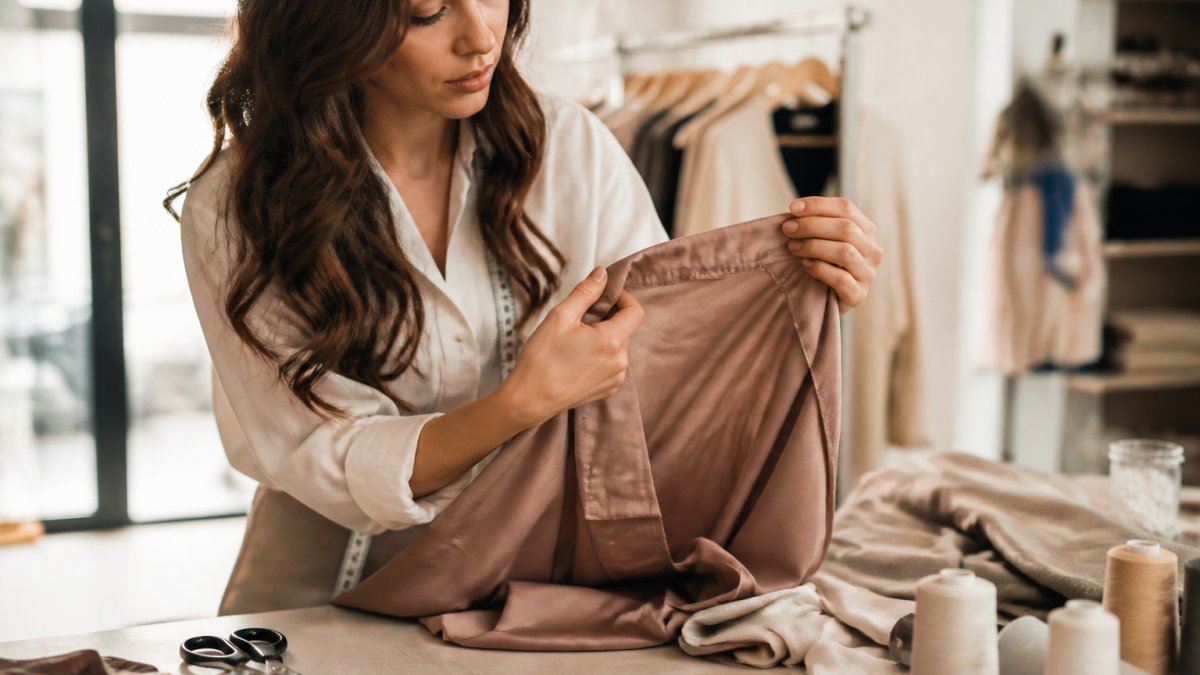
You can assess garment quality in under two minutes with your hands and eyes. Work through this checklist before you buy anything, online or in store.
- Seams lie flat with no puckering or rippling along the length
- Stitch density is tight and even, with no long, loose stitches
- Seam allowance is wide enough not to fray and is finished, not raw
- Fabric recovers when you scrunch it in your fist and release
- Pattern matching aligns at seams on prints and stripes
- Buttons and zippers feel solid, with no wobble or catching
- Lining hangs without twisting and is attached at key stress points
- Care label names specific fibers, not vague blends
Stitching, Seams, and Finishing
Seams are where cheap garments fail first. A well-made seam uses a consistent stitch length, a seam allowance wide enough to hold, and a finish, either overlocked or bound, that stops raw edges from fraying.
A common mistake is judging quality by the outside of a garment. Turn it inside out. The interior tells you far more about how it was made than the display side ever will.
Linings, Interfacing, and Hardware
Linings should be attached at the shoulders and hem, not left floating, which causes twisting after washing. Interfacing, the hidden structure behind collars and waistbands, should give shape without stiffness. Hardware should feel weighty. Thin, light zippers and hollow buttons are the cheapest components a manufacturer can buy, and they signal where else costs were cut.
Durable Clothing Materials: What Lasts and What Doesn't
Fiber content predicts lifespan more reliably than brand name or price. Natural fibers with longer staple lengths, dense weaves, and higher thread counts generally outlast loose, thin constructions and high-synthetic blends.
- Wool and merino: strong, odor-resistant, holds shape well over years
- Linen: gets softer with washing and resists pilling
- Dense cotton: durable when the weave is tight and the staple is long
- Silk: strong for its weight, but sensitive to harsh detergents
- Thin polyester blends: prone to pilling, static, and loss of shape
- Loose knits and open weaves: snag easily and stretch out
Fabric weight matters too. A heavier fabric isn't automatically better, but a garment that feels flimsy in your hand usually is.
Fast Fashion Clothing Lifespan: How Long Do Cheap Clothes Really Last?
Most fast-fashion garments fail within one to two seasons of regular wear, but the more useful question is how they fail and why. Lifespan is not a single number; it is the product of fiber, construction, and care.
The four failure modes that account for most fast-fashion retirement:
- Pilling, short fibers work loose from the yarn and ball up on the surface. It is worst in loose knits, low-grade wool, and synthetic blends, and it is accelerated by friction under bags and at the underarms.
- Seam separation, narrow seam allowances, low stitch density, and skipped finishing let seams pull apart at stress points: armholes, crotch, and pocket openings.
- Color fading and crocking, dyes that are not properly fixed bleed in the wash and rub off on skin and other garments. Dark indigo and saturated reds are the usual offenders.
- Shape loss, knits stretch at the neckline, waistband, and cuffs; woven garments bag at the knees and elbows. This is a function of fiber elasticity and how the fabric was finished, not just wear.
A common pattern is that the first failure appears after roughly five to ten home washes for a low-cost knit, and after twenty to thirty for a well-constructed one.
Lifespan also varies enormously within fast fashion. A dense cotton jersey tee with a tight knit and a reinforced neckline can outlast a cheaper, looser version by a wide margin. A simple wool sweater with fully fashioned seams will usually outlast a glued or overlocked synthetic blend.
To estimate lifespan before you buy, look for three signals: a tight, even stitch density; a seam allowance wide enough to hold; and a fiber content that matches the garment's job. A thin polyester blend marketed as a winter sweater is a lifespan problem waiting to happen, regardless of price.
Cost Per Wear Clothing: The Long-Term Value Calculation
Cost per wear is the price of a garment divided by the number of times you actually wear it.
Formula: Cost per wear = (Purchase price + repair costs − resale value) ÷ Total wears
Most guides stop at price ÷ wears.
A transparent example using round, illustrative numbers:
- Garment A, low price, worn six times before a seam fails and it is discarded. Cost per wear is high, and there is no resale value.
- Garment B, several times the price, worn sixty times over three years, with one small repair along the way. Even after the repair cost, cost per wear is far lower, and a resale or resale-platform sale recovers part of the purchase price.
The gap widens further when you factor in repairability.
Resale value follows the same logic. Well-made pieces from recognizable makers hold resale value on secondhand platforms; fast-fashion pieces typically do not.
The same reasoning applies to footwear. A well-constructed pair resoled once will usually beat three cheap pairs over the same period, because the resole extends life at a fraction of replacement cost.
Environmental Impact, Labor Conditions, and the True Cost
Fast fashion's environmental footprint comes from volume. High production runs mean more textile waste, more water consumption, and more carbon emissions per design. Low-cost clothing also depends on supply chains where labor conditions and fair wages are difficult to verify.
Ethical sourcing doesn't solve everything, but it changes the incentives. Smaller runs mean less dead stock sent to landfill. Traceable supply chains make worker rights and fair wages auditable rather than assumed. The Ellen MacArthur Foundation's work on circular fashion documents how reuse, repair, and resale extend garment life and cut waste.
Responsible shopping doesn't require perfection. Buying fewer, better pieces and repairing what you own moves the needle more than swapping one label for another.
Exceptions and Variation: When Fast Fashion Surprises and Ethical Fashion Disappoints
Neither category is uniform, and treating them as monoliths leads to bad decisions. Some fast fashion basics, particularly dense cotton t-shirts and simple knitwear, hold up better than their price suggests. Some ethical labels charge premium prices for garments with thin seams and poor finishing.
The category is a starting signal, not a verdict. Inspect the actual garment every time.
At Strawberry Flowers, our curated runway edit is selected piece by piece for construction and longevity, not just how it photographs. The Fair Labor Association's workplace standards offer a useful benchmark for what ethical production should include.
The real challenge isn't choosing between ethical and fast fashion as categories. It's developing the eye to judge a garment on its own merits, then buying fewer pieces you'll actually wear for years. Strawberry Flowers builds around that idea: signature footwear and a hand-selected runway edit chosen for construction, longevity, and statement-making design, with limited-quantity pieces that reward investment rather than impulse. Shop the runway edit.
Frequently Asked Questions
Is ethical fashion better quality than fast fashion?
Not automatically, but the odds are higher. Ethical brands typically use durable clothing materials like organic cotton, linen, and wool, and they invest in construction details such as reinforced seams and full linings. Fast fashion can mimic these looks at lower cost, but shortcuts in stitching and fabric weight often shorten the garment's lifespan. The practical test is to inspect the item yourself: check seam density, fabric thickness, and whether the label lists a specific fiber composition. A higher price does not guarantee quality, but transparent sourcing and detailed product information usually correlate with better-made clothing.
How can I compare the cost per wear of ethical and fast fashion?
Divide the purchase price by the number of times you realistically expect to wear the item. A $30 fast fashion dress worn five times costs $6 per wear. A $150 ethical dress worn 50 times costs $3 per wear. The ethical option wins on cost per wear clothing math if it genuinely lasts. Track your actual wear frequency for a month before buying to make the estimate realistic. Also factor in repairs: a well-made garment that can be rehemmed or rebuttoned extends its life and lowers its cost per wear further.
Can fast fashion clothes last for years?
Some can, especially basics made from denser fabrics like cotton jersey or denim. Fast fashion clothing lifespan varies widely by item and care. Thin synthetics, loose knits, and garments with glued rather than stitched seams tend to fail within a season. To extend the life of any garment, wash less often, use cold water, air dry, and store folded rather than hung for knits. A few fast fashion pieces will survive years of wear, but the category average is short, and the environmental cost of replacing them repeatedly adds up.
What should I check on a clothing label before buying?
Look for a specific fiber composition rather than vague terms like 'poly blend.' Check the country of manufacture and any care instructions, since garments designed for gentle washing often use more delicate construction. A label that lists a single fiber or a clear majority fiber is easier to assess for durability. Also look for certification marks if the brand claims ethical sourcing. If the label is missing fiber content or care details entirely, treat that as a warning sign about the garment's overall quality control.